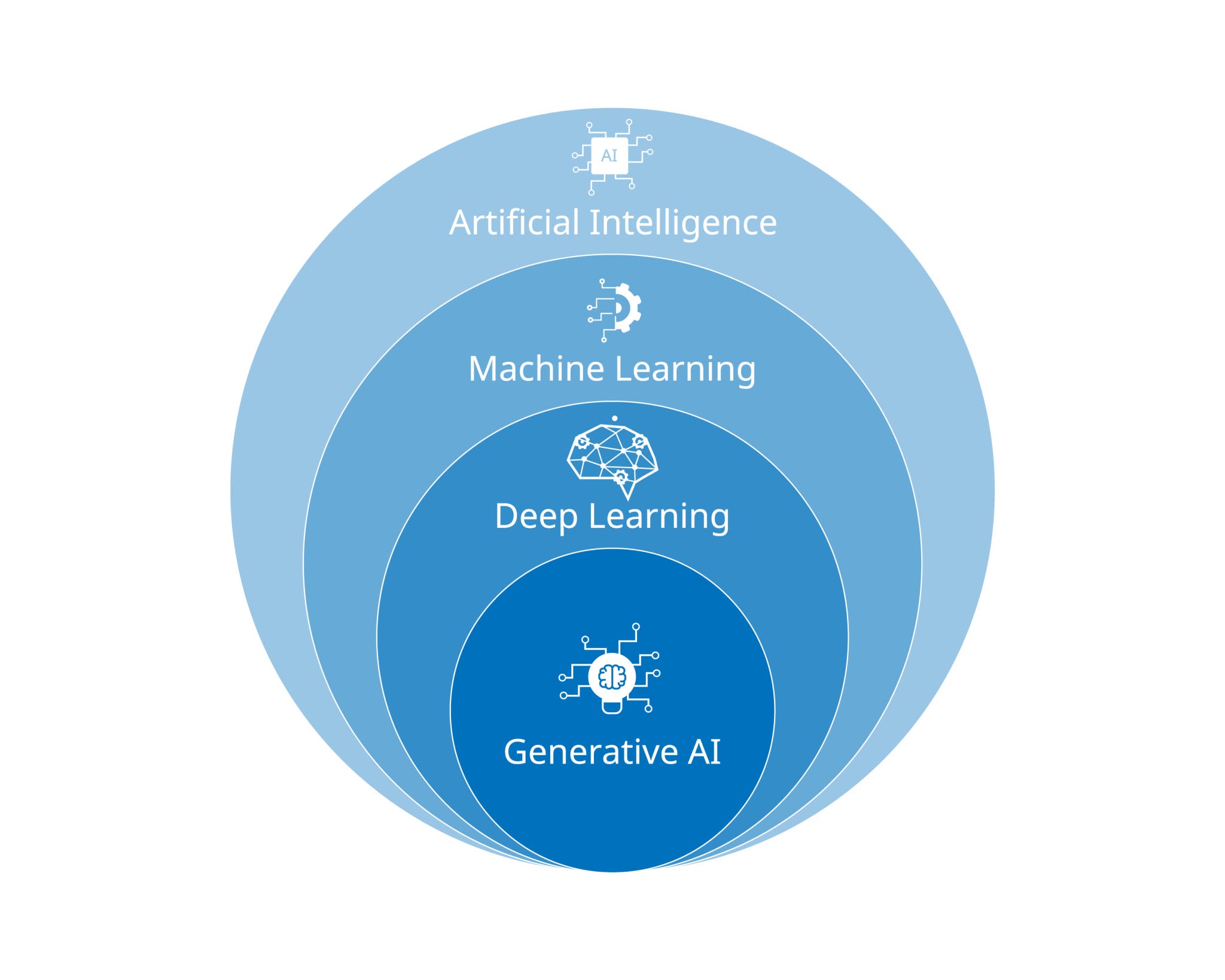
To understand the intersection of AI, ML, Automation, and Robotics, it is helpful to view them as a hierarchy of intelligence and action. While they overlap, each has a distinct set of "building blocks."
AI is the broad umbrella focused on creating systems capable of performing tasks that typically require human intelligence.
Perception: Sensing the environment through vision (Image Recognition) or sound (Speech Recognition).
Reasoning and Logic: The ability to use rules to reach approximate or definite conclusions.
Problem Solving: Heuristics and algorithms that allow a system to navigate from a starting point to a goal.
Natural Language Processing (NLP): Understanding, interpreting, and generating human language.
Planning: The ability to set a goal and realize a sequence of actions to achieve it.
ML is a subset of AI. It is the "engine" that allows AI to improve without being explicitly programmed for every scenario.
Getty Images
Data: The raw material. Without high-quality datasets, ML cannot function.
Algorithms: The mathematical formulas that find patterns (e.g., Linear Regression, Neural Networks, Decision Trees).
Features: The specific variables or attributes the model looks at to make a prediction.
Training: The process of feeding data into the algorithm so it can learn patterns.
Inference: Using the trained model to make predictions on new, unseen data.
Automation is about consistency and efficiency. It involves using technology to perform tasks with reduced human intervention.
Workflow Logic: "If-This-Then-That" (IFTTT) rules that dictate how a process should move forward.
Robotic Process Automation (RPA): Software "bots" that mimic human digital actions (like data entry or invoice processing).
Integration (APIs): The "bridges" that allow different software systems to talk to each other and trigger actions.
Monitoring: Sensors or software logs that track the status of a process to ensure it stays on track.
Robotics is the physical manifestation of these technologies. It is where AI and Automation meet the physical world.
Actuators: The "muscles" of the robot (motors, pistons) that allow for physical movement.
Sensors: The "eyes and ears" (LiDAR, ultrasonic sensors, cameras) that gather data from the physical environment.
Controllers: The "brain" (microprocessors) that processes sensor data and tells the actuators what to do.
End Effectors: The "hands" or tools at the end of a robotic arm (grippers, welders, vacuum suctions).
Power Source: The energy system (batteries, tethered power) that keeps the machine running.
Think of a Self-Driving Car:
Robotics provides the physical car, the steering motors, and the cameras.
Automation handles the cruise control and basic lane-keeping logic.
Machine Learning identifies whether a shape in the road is a plastic bag or a pedestrian.
AI makes the high-level decision to reroute the car due to an accident ahead.
To categorize 250 distinct points across all four domains (AI, ML, Automation, and Robotics), we must break them down into their technical, operational, and ethical components. Here is the exhaustive breakdown:
Artificial Intelligence (AI)
AI is the simulation of human intelligence. Its elements cover the "mind" and the "logic."
Core Cognitive Pillars
-
Reasoning: The ability to draw logical conclusions.
-
Knowledge Representation: How facts are stored (ontologies).
-
Planning: Setting and achieving complex goals.
-
Natural Language Processing (NLP): Understanding human speech/text.
-
Perception: Interpreting sensory input (vision/sound).
-
Social Intelligence: Detecting emotions and social cues.
-
Problem Solving: Heuristics to find solutions in a search space.
-
General Intelligence (AGI): The theoretical goal of human-level adaptability.
Sub-fields & Architectures
-
Expert Systems: Rules-based logic for specific domains.
-
Fuzzy Logic: Handling "degrees of truth" rather than binary true/false.
-
Evolutionary Computing: Algorithms inspired by biological evolution.
-
Symbolic AI: Using symbols to represent problems.
-
Connectionist AI: Using networks (like the brain) to represent logic.
-
Knowledge Engineering: Building the "rules" for AI.
Specialized AI Capabilities
-
Sentiment Analysis: Detecting tone in text.
-
Semantic Search: Understanding the intent behind a query.
-
Machine Translation: Translating languages in real-time.
-
Speech-to-Text (STT): Converting audio to written data.
-
Generative AI: Creating new content (text, images, audio).
-
Cognitive Simulation: Modeling human thought processes.
Machine Learning (ML)
ML is the mathematical engine of AI. These elements focus on the "learning" process.
The Data Foundation
-
Structured Data: Tables, spreadsheets, and SQL databases.
-
Unstructured Data: Raw text, video, and audio files.
-
Data Preprocessing: Cleaning and formatting raw input.
-
Feature Engineering: Selecting the most important variables.
-
Dimensionality Reduction: Simplifying data without losing meaning.
-
Data Labeling: Assigning "ground truth" to training sets.
Learning Paradigms
-
Supervised Learning: Learning from labeled examples (Input -> Output).
-
Unsupervised Learning: Finding hidden patterns in unlabeled data.
-
Reinforcement Learning (RL): Learning via rewards and penalties.
-
Semi-Supervised Learning: Mixing a little labeled data with a lot of unlabeled data.
-
Deep Learning: Using Multi-layer Neural Networks.
-
Transfer Learning: Applying knowledge from one task to a new one.
Mathematical Models
-
Neural Networks: Layers of interconnected "neurons."
-
Decision Trees: Branching logic for classification.
-
Support Vector Machines (SVM): Finding boundaries between data groups.
-
K-Nearest Neighbors (KNN): Grouping items based on similarity.
-
Random Forests: Collections of decision trees for better accuracy.
-
Backpropagation: The method for adjusting neural network weights.
Automation
Automation is the execution of repetitive tasks. These elements focus on the "process."
Industrial Components
-
PLC (Programmable Logic Controller): The rugged hardware "brain" for factories.
-
HMI (Human-Machine Interface): The dashboard operators use to control machines.
-
SCADA: Systems used to monitor large-scale industrial plants.
-
DCS (Distributed Control System): Decentralized controllers for complex plants.
-
PID Controllers: Mathematical loops that keep processes steady (like temperature).
Software & Digital Automation
-
RPA (Robotic Process Automation): Bots that "click" and "type" like humans.
-
Workflow Orchestration: Coordinating multiple automated tasks.
-
APIs: The connectors that let software talk to software.
-
Event Triggers: Actions that start based on a specific condition.
-
Scripting: Using code (Python, Bash) to automate file tasks.
Operational Characteristics
-
Repeatability: Performing the exact same task without drift.
-
Throughput: The volume of work done in a specific time.
-
Error Handling: What the system does when a step fails.
-
Integration: Connecting old "legacy" systems with new automation.
Robotics
Robotics is the physical manifestation. These elements focus on the "body" and "action."
Physical Hardware
-
Actuators: The "muscles" (electric motors, hydraulics, pneumatics).
-
Sensors: The "senses" (LiDAR, Ultrasonic, Infrared, Tactile).
-
End Effectors: The "hands" (grippers, welders, suction pads).
-
Links and Joints: The skeleton and pivots (pulleys, gears).
-
Power Source: Batteries, solar panels, or tethered electricity.
Motion and Mechanics
-
Degrees of Freedom (DOF): The number of directions a robot can move.
-
Kinematics: The geometry of motion (calculating arm positions).
-
Locomotion: How the robot moves (wheels, legs, tracks, wings).
-
Manipulators: The mechanical arms used to move objects.
-
Collision Avoidance: Path-planning to stay safe in a room.
Intelligence & Control
-
Embedded Controllers: Microprocessors that live inside the robot.
-
Feedback Loops: Sensors telling the motor to adjust in real-time.
-
Simultaneous Localization and Mapping (SLAM): How a robot maps a new room while moving through it.
-
Teleoperation: Controlling a robot from a distance.
Shared Elements (Cross-Domain)
-
Ethics: Bias, safety, and accountability across all systems.
-
Latency: The delay between sensing and acting.
-
Reliability: The "uptime" of the system.
-
Cybersecurity: Protecting the "brain" of the machine from hacks.