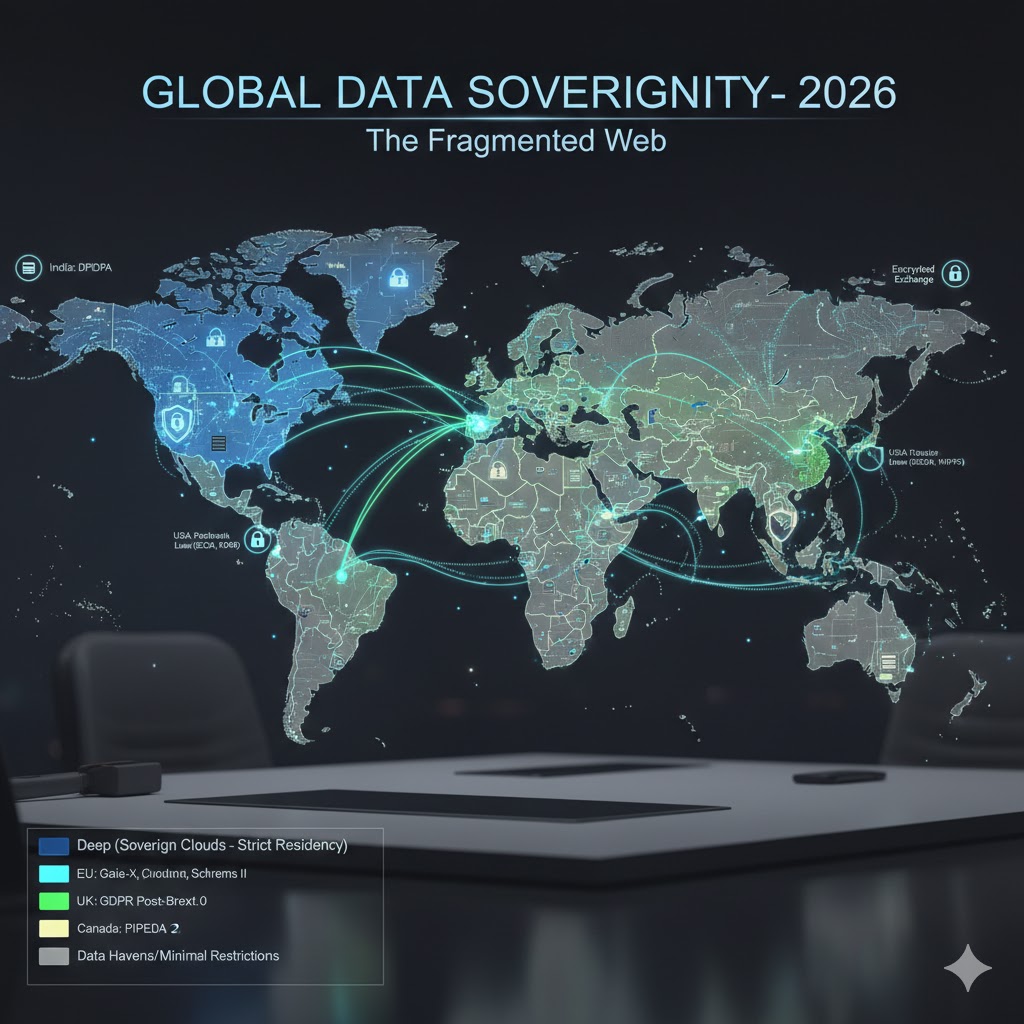
In 2026, the data landscape has become a complex "geopolitical chessboard." To give you the full picture, I have synthesized your request into a three-part masterclass: building the tech, valuing the assets, and mastering the ethics.
Building for the "Splinternet" means you can no longer have one giant database in Virginia. You need a Federated Learning (FL) architecture where the model travels, but the data stays local.
Instead of moving raw data to a central server, we move the gradients (the "lessons" the AI learns).
Local Nodes: Every region (India, EU, USA) maintains its own data silo.
Local Training: An AI model is sent to these nodes. It trains on local data and produces a set of weights ($w$).
Secure Aggregation: Only the updated weights ($w_{new}$) are sent to a central aggregator. This is done via Homomorphic Encryption, so the central server sees the updates but never the underlying data.
Global Update: The central server averages the weights (using algorithms like FedAvg) and sends the improved "Global Model" back to all regions.
Orchestration: Kubernetes-based clusters localized in sovereign cloud regions (e.g., Gaia-X for Europe).
Security: Post-Quantum Encryption (PQE) for the transmission of model weights to prevent "Harvest Now, Decrypt Later" attacks.
In 2026, data valuation has moved from "abstract" to "line-item asset."
According to the Cisco 2026 Data Privacy Benchmark, a single person's comprehensive digital profile is valued based on its "contextual utility":
Basic Identity: $1 - $5 (Email, name, basic demographics).
Financial/Spending Data: $50 - $150 (Predictive power for banks).
Genomic/Health Data: $500 - $2,500+ (Extremely high value for "Precision Medicine" drug trials).
Income Approach: Valuation based on how much revenue that data can generate via targeted AI agents.
Market Approach: Looking at "Data Exchanges" where anonymized datasets are bartered.
Cost of Loss: Increasingly, data is valued by the cost of its breach. In 2026, the average healthcare breach cost is $11.05M, making "Privacy" a direct cost-saving asset.
"Fairness" is not a universal constant. It is a cultural variable.
EU (Rights-Based): Fairness means "Demographic Parity." If an AI approves loans, it must approve them at the same rate for all protected groups, regardless of historical data.
USA (Market-Based): Fairness means "Anti-Discrimination." You must prove your AI isn't using protected attributes (like race) to make a decision, but "disparate impact" is often tolerated if there is a business justification.
India (Inclusion-Based): Fairness focuses on "Vernacular Equity"—ensuring AI models work as well in Kannada or Marathi as they do in English.
To be 2026-compliant, your AI must pass three tests:
Statistical Test: Does the model's error rate vary by more than 2% across different demographics?
Explainability Test (XAI): Can the model explain its decision in plain language to a human auditor?
Adversarial Test: Can a specialized "Red Team" trick the AI into making a biased or harmful decision?
| Sector | Tech Move | Economic Value | Ethical Standard |
| Healthcare | Federated Learning | High ($2k/record) | Safety & Consent |
| Finance | Differential Privacy | Medium ($100/record) | Fairness & Integrity |
| Retail | Edge Processing | Low ($10/record) | Transparency |
In 2026, the data narrative is shifting from "What is data?" to "Who owns the agency of data?" We are entering the era of Self-Sovereign Identity (SSI) and Agentic Data Management. Here is the roadmap of what is happening right now and what is coming next in the global ecosystem.
The Rise of the "Personal Data Locker" (SSI)
The most significant shift in 2026 is the death of the "Centralized Login." Instead of Google or Facebook holding your keys, you hold them in a Digital Wallet.
-
Verifiable Credentials: You carry digital versions of your passport, degree, and credit score. When a bank needs to verify you, they ping your wallet. You grant access for 30 seconds, and they never "store" your data—they just verify the cryptographic proof.
-
The End of "Honeypots": Because companies no longer need to store your raw PII (Personally Identifiable Information) to verify you, the giant databases that hackers love to target are disappearing.
-
Selective Disclosure: You can prove you are "Over 21" or "Resident of India" without revealing your birth date or home address.
Agentic Data Management: AI that "Self-Heals"
We are moving away from data engineers manually fixing broken pipelines. In 2026, Data Agents are the primary workforce.
-
Self-Healing Pipelines: AI agents now monitor data flows in real-time. If a sensor in a factory fails or a schema changes in a marketing database, the AI detects the "drift" and automatically rewrites the integration code to fix it.
-
Know-Your-Agent (KYA): As we use AI agents to shop or manage our finances, businesses now have "KYA" protocols. They need to verify that your AI bot has the legal authority to spend your money or sign a contract on your behalf.
-
Unstructured as Structured: LLMs have made text, video, and audio as searchable as an Excel sheet. 80% of enterprise data was previously "dark" (unusable); in 2026, it is all queryable in real-time.
The "Human-Centric" Correction
As AI takes over routine data processing, the global economy is placing a massive premium on Human Context.
-
The "Experience Economy": While AI handles the data, humans are being hired for judgment. Roles in healthcare, ethics auditing, and high-level strategy are growing 60% faster than pure technical coding roles.
-
The Right to "Human-in-the-Loop": New laws in 2026 (especially in the EU and India) mandate that any AI-driven data decision affecting your life (like a job rejection or a medical diagnosis) must have a "Human Review" button.
Summary: The 2026 Data Evolution
Feature
2020-2024 (The Past)
2026 (The Present/Future)
Storage
Centralized Cloud
Sovereign & Edge Clouds
Identity
Username/Password
Self-Sovereign Wallets (SSI)
Processing
Manual Pipelines
Self-Healing AI Agents
Value
Targeted Ads
Direct Data Bartering & Utility
Trust
Terms of Service
Zero-Knowledge Proofs (ZKP)
In 2026, the job market has split into two categories: those who manage data and those who orchestrate agents. To stay ahead, you need a roadmap that balances deep technical "moats" with high-level strategic "agency."
Here is your 2026 Data Career & Skill Roadmap.
The 2026 "Power Skills" Hierarchy
Gone are the days when knowing "just Python" was enough. The new hierarchy is built on Privacy, Autonomy, and Orchestration.
Skill Tier
Key Technologies to Master
Why it matters in 2026
Data Orchestration
MCP (Model Context Protocol), Airflow, Dagster.
Managing how LLMs interact with external tools and live data sources.
Agentic AI Ops
LangChain, LlamaIndex, Agent Ops tools.
Transitioning from "chatbots" to autonomous agents that execute workflows.
Privacy Engineering
Zero-Knowledge Proofs (ZKP), Federated Learning.
Processing data without ever "seeing" it (crucial for Healthcare/Finance).
Sovereign Cloud
Gaia-X, AWS/Azure Sovereign Regions.
Building systems that legally must stay within national borders.
Core Foundation
Advanced SQL (Window functions), Python, Cloud.
The "unshakable" base that every high-level skill sits on.
Emerging Job Titles & Salary Trends
The most profitable roles in 2026 didn't exist three years ago.
-
Orchestration Engineer: Designs "fleets" of AI agents to work in sync.
-
USA: $140k – $190k | India: ₹15L – ₹35L
-
Data Ethicist / Governance Specialist: Audits AI for bias and ensures compliance with laws like the EU AI Act.
-
USA: $130k – $170k | India: ₹12L – ₹28L
-
Privacy Architect: Implements ZKP and Homomorphic Encryption to secure sensitive pipelines.
-
USA: $160k – $220k | India: ₹20L – ₹45L
-
Policy Data Specialist: Managing data for government and regulatory bodies.
-
India (Govt/Contract): Up to ₹22L
The 2026 Certification "Gold Standard"
In 2026, vendor-specific and security-focused certs carry the most weight.
For Beginners
-
Microsoft AI-900 / Google AI Essentials: Best for understanding the business and prompt side.
-
Google Data Analytics Professional: Still the best entry point for foundational SQL/R/Python.
For Professionals (The "High-Salary" Certs)
-
Google Professional Machine Learning Engineer: Focuses heavily on MLOps and production.
-
AWS Certified Machine Learning – Specialty: The global standard for enterprise cloud AI.
-
NVIDIA AI Infrastructure & Operations: Essential for those managing the "hardware" (GPUs/Data Centers).
-
Databricks Certified Data Engineer Associate: Focuses on the modern "Lakehouse" architecture.
Your "Next 6 Months" Action Plan
-
Month 1-2 (The Foundation): Master Advanced SQL and Cloud Basics (AWS/Azure). If you can't query a database, you can't feed an AI.
-
Month 3-4 (The Pivot): Learn Agentic Frameworks (LangChain/MCP). Build a simple agent that can "read" an email and "update" a database autonomously.
-
Month 5-6 (The Moat): Specialize in Privacy (ZKP basics) or Orchestration (Airflow). This is what separates you from the 11 million other "basic" analysts entering the market.
2026 Career Tip: Don't just learn to code; learn to delegate. In 2026, your value is measured by how many "digital teammates" (AI agents) you can successfully manage.