This Chapter is dedicated to give an introduction about the Data. Data are very important part in Computer Science Studies.
How Data has been clasified under different varieties and why should we needs to learn that every data associated with a different types of domain should contains information for that particular domain only.
Now, domains are related to various fields who hold their respective datas-&-informations to solve their day-to-day purposes.
These Fields must include following points:
Programming and Coding Domain; Data Analytics and Visualizing Domain;
In 2026, the concept of Data has moved far beyond simple spreadsheets. It is the fundamental building block of reality, acting as both the "new oil" that fuels our economy and the "nervous system" of our global infrastructure.
Whether it's a binary digit on a server or a physical mark on a tree, data is essentially a recorded observation.
Whether it's a binary digit on a server or a physical mark on a tree, data is essentially a recorded observation.
In the digital realm, data is information converted into a format that a machine can process. By 2026, this is increasingly handled at the "Edge" (locally on devices) rather than just in giant central clouds.
| Data Type | Description | 2026 Context |
| Structured | Highly organized, tabular data (SQL, Excel). | Used for high-speed financial transactions and inventory. |
| Unstructured | Content with no fixed format (Video, Audio, Social Media). | Now easily "read" by AI to understand human sentiment and behavior. |
| Metadata | "Data about data" (GPS tags on photos, time-stamps). | Essential for Data Governance and verifying the origin of AI content. |
| Streaming | Real-time, continuous data flow. | Powering self-driving cars and live fraud detection systems. |
In "analog" or biological systems, data exists as physical evidence or sensory inputs. Before the first computer was built, humans were already "data scientists" using physical tools.
Biological/Genetic: DNA is the ultimate non-computing data storage. A single gram of DNA can theoretically store 215 petabytes of data. In 2026, synthetic biology uses this "data" to design new medicines.
Environmental: Tree rings (dendrochronology) and ice cores act as historical "hard drives," storing thousands of years of climate data.
Sociological/Physical: Paper records, tally sticks (like the ancient Ishango bone), and even the layout of a city are physical data points that tell us about human behavior and history.
Cognitive: Human memory and sensory perception (sight, sound, touch) are the raw data our brains process to create "information" and "wisdom."
Data now bridges the gap between the physical and digital worlds through Digital Twins—virtual replicas of physical objects (like a jet engine or an entire city) that update in real-time based on physical sensors.
Healthcare: Genomic data is used for "Precision Medicine," where your specific DNA data dictates your treatment.
Finance: "Agentic AI" analyzes global market data in milliseconds to execute trades and manage risks.
Governance: Smart Cities use data from traffic lights, waste bins, and power grids to optimize urban living.
Crucial Distinction: Data is raw. Information is processed. > * Data: 38.5 (Just a number)
Information: 38.5°C (A high body temperature)
Wisdom: "I should see a doctor."
In 2026, regulators like the FTC and the EU AI Office are actively fining companies for "legalese obfuscation." A modern privacy notice must be skimmable, honest, and—most importantly—written for a human, not a robot.
Below is a template for a high-trust, 2026-compliant privacy notice for an AI-driven service (e.g., a Health-Tech or Fin-Tech app).
Last Updated: February 24, 2026
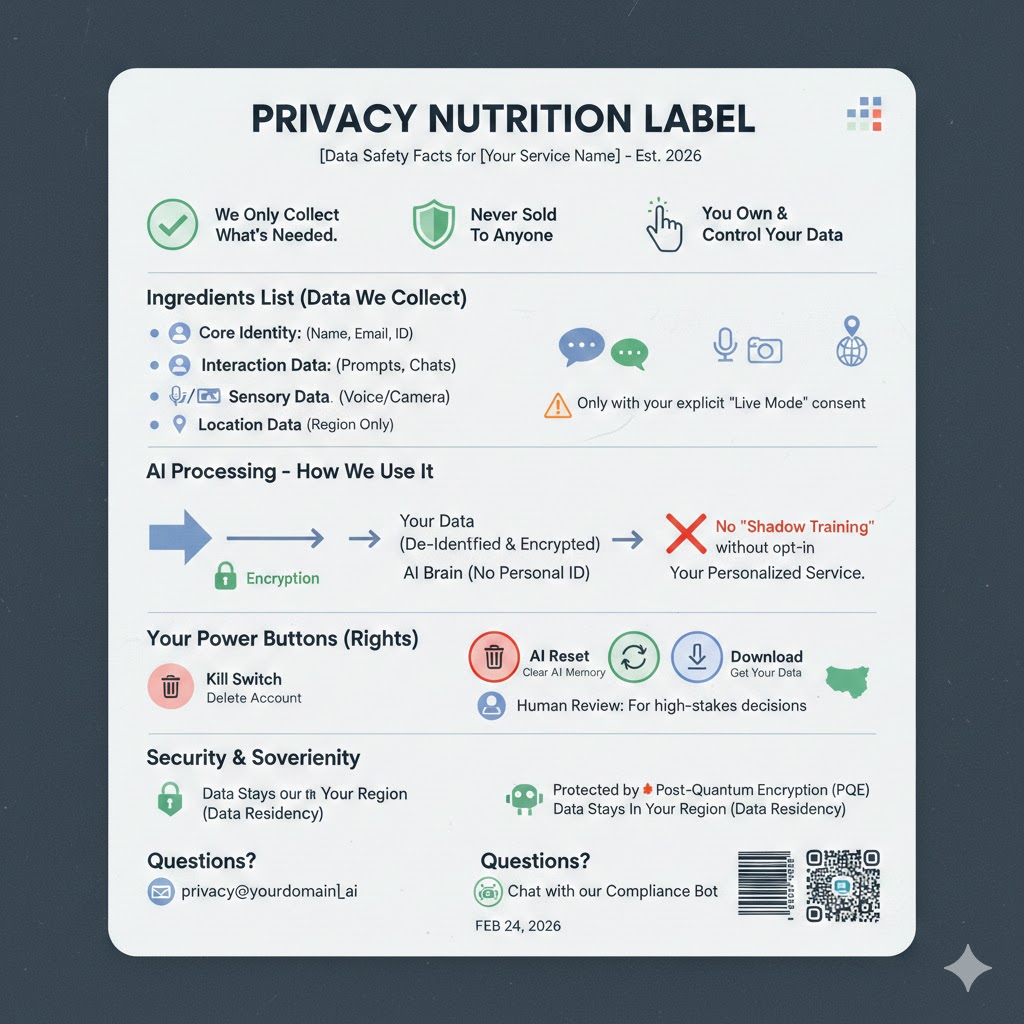
We only collect what we need to make the AI work for you.
We never sell your personal identity to data brokers.
You own your data. You can delete it, or your AI's "memory" of you, at any time.
We use a Data Minimization approach. If it’s not essential, we don't touch it.
| Data Type | What it is | Why we need it |
| Core Identity | Name, Email, Verifiable ID. | To keep your account secure and meet "Know Your Customer" (KYC) laws. |
| Interaction Data | Your prompts and AI chats. | To help the AI understand your context and improve its answers. |
| Sensory Data | Optional Voice/Camera access. | Only used when you trigger "Live Mode" features. |
Our AI models are designed with Privacy by Design.
Local Processing: Whenever possible, your data stays on your device.
De-identification: Before our "Brain" (the central model) learns from your trends, we strip away your name and ID. It learns what happened, not who did it.
No "Shadow Training": We do not use your private messages to train our public models unless you explicitly opt-in to our "Beta Research" program.
In 2026, you have full control over your digital twin. You can:
The Kill Switch: Delete your entire account and all associated data instantly.
AI Reset: Clear the AI’s short-term memory of your recent conversations without deleting your account.
Data Portability: Download a machine-readable file of everything we know about you.
If our AI makes a high-stakes decision (like a credit limit or a health suggestion) that you disagree with, you have the Legal Right to Human Review. * Click the "Request Human" button in your dashboard to have a specialist review the AI’s logic.
Encryption: Your data is protected by Post-Quantum Encryption (PQE).
Storage: If you are in the [EU/India/USA], your data remains on servers located within your region to comply with local Data Residency laws.
Reach out to our Data Privacy Officer (DPO) at privacy@[yourdomain].ai or chat with our Compliance Bot for an instant answer.
Professional-Tip for 2026: To be truly compliant, this notice should be paired with a "Nutrition Label"—a visual graphic that summarizes data safety, similar to those found on food packaging or the Apple App Store.
Since we’ve covered the what (Data), the where (Domains), and the how (Privacy), the next logical step in our 2026 journey is Data Sovereignty and the Global "Splinternet."
In 2026, the internet is no longer a single, open highway. It has become a series of "walled gardens" dictated by national laws and geopolitical boundaries. This is where data meets global politics.
Countries are now demanding that their citizens' data not only be protected but physically stored and processed within their borders.
India’s Digital Personal Data Protection Act (DPDPA): Enforces strict localization for "critical" data.
The EU’s Gaia-X: A project to create a European data infrastructure to reduce reliance on US and Chinese cloud giants.
Result: Companies must now maintain "micro-data centers" in every country they operate in, rather than one giant hub.
We are seeing a shift from a World Wide Web to a Federated Web.
The West: Focuses on individual privacy and corporate accountability (GDPR/CCPA/EU AI Act).
China/BRICS+: Focuses on state security and collective data control.
The Impact: If you are a global business, your AI might need to "forget" things as it crosses borders to stay legal.
In 2026, "Data Treaties" are the new Trade Agreements. Countries are trading access to their citizens' anonymized health data in exchange for green energy or physical infrastructure. Data is literally being bartered on the global stage.
This is an introductory portion only, later-on I extend it.
Data have various types which I'm going to covered in Subsquent Chapters.
Broad Headings of Data:
1. Banking; 2. Agriculture; 3. Education; 4. Corporate; 5. Finance; 6. Geographical; 7.Medical; 8. Research-&-Development; 9. Scientific; 10. Music;
In 2026, data privacy is no longer just a legal checkbox; it has become a core technical architectural requirement. As AI integrates into every corner of our lives, the focus has shifted from protecting stored data to protecting data in use.
Here is how the Healthcare and Finance sectors are managing this transformation.
Healthcare: Privacy-First Medical Intelligence
In healthcare, the goal is to use massive datasets to save lives without ever "seeing" the raw patient data.
-
Federated Learning (FL): Instead of hospitals sending patient records to a central server to train an AI, the AI travels to the hospitals. The model learns locally on the hospital's private data and only sends back "encrypted brain updates" to the central system.
-
Homomorphic Encryption (HE): This allows AI to perform calculations on encrypted data without ever decrypting it. For example, a diagnostic tool can analyze an encrypted X-ray and return an encrypted result, ensuring the service provider never sees the actual image.
-
Zero-Knowledge Proofs (ZKP): Used for patient identity and prescriptions. A pharmacy can verify you have a valid prescription without knowing your full medical history or even your name.
Technology
Benefit in 2026
Edge AI
Processes health data on your smartwatch, not the cloud.
Post-Quantum Encryption
Protects genomic data against future quantum computer attacks.
Digital Twins
Allows testing of drugs on virtual patient replicas to avoid data risk.
Finance: Decentralized and Autonomous Privacy
The financial world in 2026 is grappling with "Agentic AI"—AI systems that can hold funds and execute trades on their own.
-
DeAI (Decentralized AI): To prevent a single bank from having a "God View" of all transactions, institutions use decentralized networks. They share fraud patterns (e.g., "this behavior looks like money laundering") without sharing the actual names or account details behind the transactions.
-
Tokenization & Masking: Real-world assets (like real estate or stocks) are converted into digital tokens. Your identity is "masked" by a token that only authorized regulators can "unmask" under specific legal conditions.
-
Differential Privacy: When banks release economic reports, they add "mathematical noise" to the data. This ensures that while the overall trends are 100% accurate, no one can work backward to identify a specific individual's spending habits.
Global Regulatory Convergence
The legal landscape has become significantly more aggressive in 2026.
-
EU AI Act Implementation: By August 2026, high-risk AI systems (like those used in surgery or credit scoring) must provide "Documented Transparency." Companies must prove their AI isn't biased and explain how it reached a decision.
-
The End of "Dark Patterns": New laws in the US, UK, and India now strictly ban "manipulative design"—interfaces that trick users into sharing more data than they intended.
-
Sovereign Data Clouds: Many countries (like India and Australia) now mandate that sensitive citizen data must stay within physical borders, forcing global companies to build local, isolated data centers.
The 2026 Mantra: "Privacy by Design"
In the past, privacy was a "bolt-on" feature added at the end. In 2026, if a system isn't built with privacy at its core (Privacy by Design), it is legally and technically considered broken.
In 2026, the strategy for data privacy has shifted from "defensive compliance" (avoiding fines) to "competitive trust" (using privacy as a brand advantage).
The following breakdown compares the two most regulated sectors and provides a practical checklist for any business navigating this landscape.
Sector Comparison: Healthcare vs. Finance
While both handle sensitive data, their primary risks and regulatory focuses differ in 2026.
Feature
Healthcare (The "Safety" Priority)
Finance (The "Sovereignty" Priority)
Highest Risk
Life-safety & diagnostic errors from biased AI.
Instantaneous, automated fraud at scale.
Top Concern
Data Leakage: Patient records are "permanent" (you can't change your DNA).
Data Integrity: Ensuring AI agents don't hallucinate "phantom" funds.
Primary Tool
Federated Learning: Training models on local devices to keep data private.
Differential Privacy: Adding "noise" to data so individual trends are hidden.
Key Regulation
HIPAA (US), EU AI Act (High-Risk), India DPDPA.
SEC Cybersecurity Rules, EU AI Act, DORA (Digital Resilience).
Breach Cost
$11.05M avg. (Highest of all sectors).
$6M - $9M avg. (Highest frequency of attacks).
2026 Data Privacy Checklist
If your business is deploying AI or handling global data this year, these are the non-negotiable steps for compliance.
A. Governance & Inventory
-
[ ] AI Inventory: Do you have a list of every AI system used? (Includes 3rd-party SaaS tools and internal "Shadow AI").
-
[ ] Risk Classification: Have you labeled your systems as "High-Risk" per the EU AI Act (e.g., credit scoring, hiring, health diagnostics)?
-
[ ] Ownership: Is there a specific person accountable for each AI model's privacy?
B. Technical Controls
-
[ ] Human-in-the-Loop (HITL): For high-risk decisions, is there a "Stop" button or a human override?
-
[ ] Prompt Sanitization: Do you have filters to prevent employees from putting sensitive customer data into LLMs?
-
[ ] Automated Deletion: Can your system execute a "Right to be Forgotten" request across both databases and trained AI models?
C. Transparency & Legal
-
[ ] Plain Language Notices: Is your privacy policy readable by a human, or is it 40 pages of legalese? (2026 regulators are now fining for "obfuscated" policies).
-
[ ] Consent Managers: For users in India or the EU, are you using a registered Consent Manager to track permissions?
-
[ ] Bias Testing: Can you produce a report proving your algorithm isn't discriminating based on age, gender, or race?
The "Vibe Check": Automated Audits
In 2026, regulators (especially in the US and EU) are using automated crawlers to check your website's backend code. They don't just look at your "Accept Cookies" banner; they check if your server-side trackers stop the moment a user clicks "Reject."
Professional-Tip: Don't rely on manual spot-checks. In 2026, if you can't prove your compliance with a timestamped log "immediately," you are considered non-compliant.